In search of healthy and fun meals to feed my family, with an eye toward sustainable living.

Here you'll find recipes & ramblings about keeping my family fed with what's available in Alaska between local produce, a little bit of wild harvest, and the modern grocery store.
Showing posts with label clean-out-the-frig-recipe. Show all posts

Thursday, December 31, 2009

New Year's Menu

It's New Year's Eve, and I've been cooking up a proverbial storm.
First of all there's the tradition in our family to turn the last of the Christmas turkey leftovers into a tasty batch of GUMBO, which usually is done by the dear husband -- but I made it today while he napped on the couch... Sooo, I won't be revealing any of HIS secrets of Gumbo-making, merely my own (albeit probably inferior, or at least less fiery) version.
New Years Gumbo

left-over turkey, cut into small pieces
turkey stock -lots!
oil, such as canola, sunflower, or other oil that can handle being heated
For starters, the trinity of cajun vegetables:
onions, chopped
celery, chopped
bell peppers, chopped
jalapeno peppers (or other hot peppers), chopped
optional meats: ham, sausage
garlic, crushed
pepper (both black and white, best if freshly ground)
ground cumin (a goodly amount)
cayenne pepper (to taste, or other hot pepper, ground)
ground paprika (smoked is great for flavor!)
thyme (generous amount -- this is a signature of cajun cooking!)
oregano, basil
onion powder, garlic powder
stewed tomatoes, canned ok, with liquid
bay leaf
water or stock
sweet potatoes, cubed
other veggies, such as green beans, okra, carrots, turnips...
salt, to taste
tabasco sauce
oil and flour, roughly equal amounts, for making roux
optional: seafood, such as shrimp

Note that I do not list quantities, because it's (a) a function on what you happen to have at hand right then -- in other words, clean-out-the-frig, and (b) it's a matter of taste -- give your creativity free reign: no 2 batches of gumbo should ever be the same!

I start by heating the defatted stock in my largest stockpot, adding the turkey and all other ingredients as I saute them in my biggest cast-iron frying pan: First, I sautee the onions, celery & peppers, adding the spices and cooking a bit. After they're done, dump that into stockpot, add more oil to the frying pan, and sautee the next batch: sausage, ham, etc... The sweet potatoes onward do not need to be sauteed -- they go directly into the stockpot.

While the big pot is bubbling away (on low), make the roux:
This takes some skill & confidence, but most importantly, the knowledge that it can splatter and burn you! I heat the oil in the cast-iron pan, and add flour while whisking it continuously. Heat and keep whisking until the flour turns dark, but don't burn it.
Remove from heat and spoon roux into the stockpot in small batches -- it's VERY hot and can splash when it hits the liquid -- it really helps to have a spouse or older child there who will stir the big pot after each addition of roux. Simmer the stockpot, letting flavors mingle and gumbo thicken, but keep an eye on it, stirring occasionally. If I want to add shrimp, I do it at this stage.
Note: this freezes very well -- but don't add shrimp or other seafood until thawing and re-heating.
Serve gumbo over rice.

Note on roux-making: another approach commonly seen is starting with the roux. Heat oil, add flour and whisk until dark. Then add the veggies and spices and cook, stirring. Add stock, stirring... Note that this approach requires all your ingredients to be ready to go, and you do a lot of continuous stirring, and my wrist/arms need breaks -- so I do like to do this in batches.

For a recipe (with actual quantities), go here for a Paul Prudhomme gumbo.

Next, I cooked Hoppin' John, which is a Southern tradition, made from Black-eyed peas (a.k.a. cowpeas), and I made both a vegetarian and traditional version.

Hopping John
tradional version: cook cowpeas with ham, hamhock or bacon
my own vegetarian creole version:
black-eyed peas, soaked in warm water for a few hours or overnight, drained
oil
onions, chopped
celery, chopped
bell peppers, chopped
garlic, crushed
pepper (both black and white, best if freshly ground)
cayenne pepper (to taste, or other hot pepper, ground)
ground paprika (smoked is great for flavor!)
thyme (generous amount -- this is a cajun staple)
optional: onion powder, garlic powder, mustard powder
bay leaf
water or stock
salt, to taste
greens, such as kale or collard greens.

Heat oil and saute the veggies. Add garlic and all spices, cooking for a little while, then add the drained black-eyed peas, bay leaf and enough water/stock to cover. Cook until peas are soft. Add salt.
While legumes are cooking, prepare the greens: wash, remove tough stems, and cut. Add into peas when they are nearly all the way cooked. Serve with cornbread.

Lastly, as I type on my new laptop (in the kitchen, isn't that nifty!!!), I've got 2 different versions of poached pears simmering on the stove. I posted the recipe yesterday, but here's what I've learned today when I found this treatise on How to make poached pears (go there if you want actual measurements!):
  • This works with Asian pears too!
  • Keep those pears covered with some parchment paper
  • there are lots of flavors you can add: vanilla, cloves, allspice, etc
  • try replacing some of the water with wine
  • add some dried fruit to the poaching liquid at the end
  • serve hot or cold, by itself or with a sauce
  • it's a great way to preserve fruit you can't eat fast enough...

Saturday, December 26, 2009

Menu for last week of December

It's that wonderful week after Christmas, when the frig is full, but the calendar is not!

We're about cookied-out, and I find myself craving mostly fruits and vegetables. Perfect for all that wonderful produce from the CSA box: carrots, taters, celery root, cabbage, pears, apples, oranges, greens, etc.
At Costco I bought 2 special treats: King Crab, and Leg of lamb, imported from Australia.
The lamb will last me a few month: I cut it up into chunks and freeze it in 1-pound portions, plus I make stock from the scraps...) I love making an indian feast with lots of vegetarian dishes plus lamb korma or lamb stew!

An old Southern tradition is to eat black-eyed peas and greens on New Year's Day -- so we're adding this to our family tradition. My Swedish-American husband is the force behind our family's predeliction for CAJUN food -- every year for the last 17 we turn the turkey left-over into a great big batch of GUMBO. It freezes very well!

SAT "Boxing Day": leftover turkey, mashed pototoes, etc.
SUN: Polenta w/ red sauce, super-garlicky garlic bread, big green salad
MON: Cajun Flanks & greens, over rice, oven-roasted celery root
TUE: Bubble & Squeek (potatoes and cabbage)
WED: Cardamon Lamb Curry (recipe from Dingo Dave Downunder), other veggies & rice
THUR: Gumbo and King Crab (more here)
FRI: Cajun black-eyed peas, mess of greens, cornbread
SAT: Corned beef, potatoes & cabbage

Wednesday, October 28, 2009

The British Isles


This week's theme seems to be evolving into the cuisine of the British Isles. We have a ton of potatoes (after finishing our own harvest of red potatoes, I stocked up with a big sack of Valley-grown, organic, absolutely delicious "German Butterballs"). There's lots of cabbage around, of course, and there have been repeated calls for Bubble & Squeak, a British dish that combines potatoes and cabbage.
I had to promise the Prof that there would be no Haggis, but maybe Bangers and Mash..?

We started with corned beef on Sunday. From the left-overs, I made a family favorite: Gimme-More-Pie, my own invention, and named by a bunch of kids calling "Gimme more pie" at the dinner table several years ago...

Gimme More Pie
any good piecrust, doubled, so there's a top too!
left-over meat, cut into small pieces (roast beef or corned beef)
left-over vegetables, cut up (carrots, potatoes, other firm vegetables)
left-over gravy
onions, spices (garlic & onion powder, thyme, etc), salt & pepper

If I don't have enough left-overs to put into the pie, I add more as I cook this!
Saute onions, add vegetables and meat, spices, and gravy (if necessary, I cheat and use a gravy mix). Taste, and add spices as needed or desired. Let filling cool.
Prebake piecrust, if desired.
Fill pie and cover with extra crust. Cut slits for steam to escape (if you want to get fancy, cut our shapes with cookie cutter). Bake at 375 Fahrenheit until crust is done (approx 35-45 min).

Other main dish pies that come to mind are Shephard's Pie -- similar idea, but replace the topping with mashed potatoes (sometimes cheese is added).

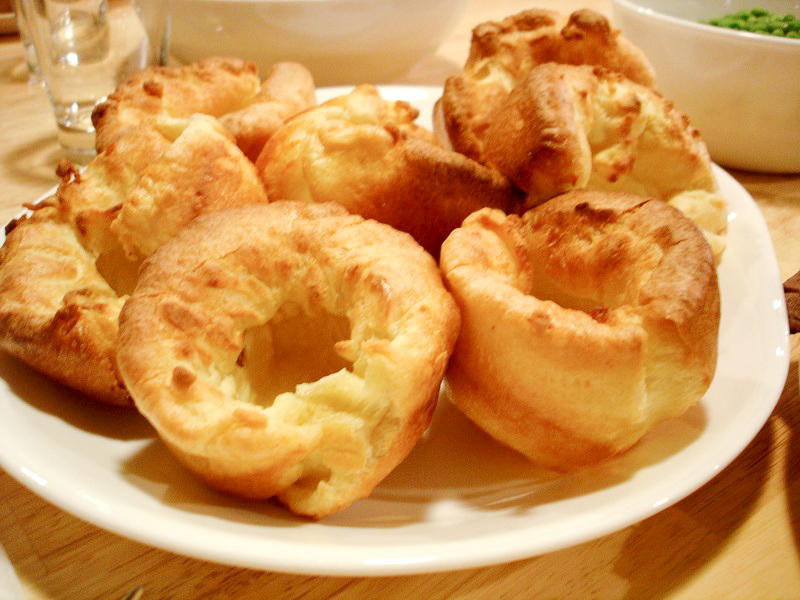
Yorkshire Pudding
Bread-like accompaniment for British main meals. These are made from a batter similar to pancake batter (flour, eggs, milk) and cooked in hot grease or meat drippings. It really is very similar to what Americans call Popovers.
My recipe is:
1 cup flour
1 c milk
3 eggs, beaten
optional: grated cheese, such as Parmesan
salt
melted butter for muffin tins

Bake 1/2 hour in hot oven (400 F), no peeking!

Irish Stew
An Irish stew would have beef (or mutton) and lots of root crops: potatoes, carrots, celery, onions, turnips, etc.
Making stew is so easy, and so satisfying -- use good stock (see here for my post on homemade), and don't forget the bay leaves!

Irish Soda Bread
Soda Bread recipe from Recipesource.com
3      cups          Unbleached white flour
2 teaspoons Baking powder
2 cups Raisins
1 teaspoon Baking soda
1 Egg
1/2 teaspoon Salt
1/2 cup Honey
12 tablespoons (1 1/2 sticks) sweet butter, cold
1 cup Buttermilk

Makes 1 large loaf.

Preheat oven to 350F.

Sift the flour, baking powder, soda and salt into a large mixing bowl. Cut
the butter into small pieces and add. Cut it into the flour with a pastry
blender until the mixture is the size of peas. Add the raisins and toss to
distribute evenly, using two forks.

Beat the egg in another bowl until very frothy. Beat in the honey. When
it is well blended, beat in the buttermilk.

Gradually pour the liquids into the flour, tossing all the while with a
fork so the mixture gets evenly moistened. Continue tossing lightly with
two forks until the batter comes together; it doesn't have to be completely
mixed and should be very rough and lumpy.

Butter a heavy skillet or casserole, 10 to 11 inches in diameter and 2 to
3 inches deep. Round is the traditional shape. Spoon batter out into the
pan and push it gently to fill the pan. It can mound up somewhat in the
middle. Bake at 350 F about an hour or until the middle is set. Cut out a
piece to test if necessary.

Cut into wedges and serve warm from the pan.

The Garden Way Bread Book From the collection of Jim Vorheis

Monday, April 13, 2009

Left-over roast of mutton


For Easter dinner, we had a lamb roast -- but on account of our youngest guest who arrived with her favorite stuffed purple "lambie", we just said we were having "mutton" for dinner, and despite a few slip-ups by the adults "pass the lamb/er mutton", Little One never questioned the origin of the roast at the table.

Having leftover meat is one of those things where I'm in need of inspiration. And a few years ago I stumbled upon this set of recipes -- the first based on a real dish, the second entirely my creation.


Miner's or Cornish Pasties

(pronounced with a soft "a")
from Chef Paul Prudhomme's Seasoned America, based on the recipes from Cornish miners who settled Michigan's Upper Peninsula.
ASIDE: I also found a much simpler recipe for Finnish Miner's Pasties (Lihapastaejat) in Beatrice Ojakangas The Great Scandinavian Baking Book. She tells how miner's wives would bake these fresh in the morning with beef, potatoes and onions at one end, and apple filling at the other end for dessert. The traditional recipe calls for the potatoes to be sliced and added raw, but it also works to use cooked.
I make this with leftover corned beef or whatever I have at hand, and I prepare all the steps ahead, until assembly time. These also make great lunches!

Seasoning mix: 1 teaspoon each salt, onion powder, garlic powder, thyme, basil, black pepper.
optional, add ground savory.
(I found that was more than I ended up using, but was able to use it easily in other cooking)
Dough:
2 c flour
1 t seasoning mix
6 T butter
7-8 T cold water

Use pastry cutter, or Cuisinart to mix dough. Form ball and refrigerate 1 hour.

Filling:
up to 1 pound meat (lean, chopped very finely), or left-over roast or corned beef
seasoning mix, to taste
2 c onions, chopped
1 c celery, chopped
1-2 c turnips, finely sliced
fresh garlic
potatoes, sliced thinly

If using raw meat, sprinkle it with seasoning mix, and work in by hand.
Heat oil and saute vegetables, add meat, more seasoning if desired. Add small amounts of water as needed. Let it cool completely (frig) before assembling pasties.

Assembly:
Divide dough into 5 balls and roll out (circa 9 " diameter). Place filling (plus raw potato slices, if using) onto half, fold over (after brushing edge with water to help seal), crimp the edges.
Optionally, brush with egg-wash (scramble an egg with 1-2 T water), and bake for about 1 hr at 350 F.

Gimme-more Mutton Pie
Same idea, invented by moi, named by the huz & kids!

Dough:
2 c unbleached white flour
1/2 c whole wheat
1 stick butter (cold, cut into pieces) = 8 T
1/2 c cold water, about
salt

I use the cuisinart: first use pulse setting until get crumbly mix, then slowly drizzle water while blade is running. Mix into ball and refrigerate in waxpaper for 1 hr. Roll out dough, top and bottom.
Prebake bottom for 10-15 min, using pieweights.

Filling:
Same idea as Miner's pasties above. Any good leftovers can be used that way. If ingredients are very dry, add some gravy. You can also grate a raw potato into the filling to help absorb liquids if too moist!

Assemble pie, cut shapes or slits into top to let steam escape.
Bake for 45 min-1hr.

Monday, March 16, 2009

New Recipes from our CSA

It feels like the night before Christmas...Actually, it's the night before our CSA box from Glacier Valley Farm arrives, and that's a lot like Christmas! Because we were gone over Spring Spring, we didn't get a box last week, but now I'm all excited about the arrival of tomorrow's, which comes with a whole new set of recipes.

I'm so tickled about how the family is on board with the CSA box and healthier eating. Eldest (off in college) is probably wishing I would have done this YEARS ago (but I don't think they had much in a way of CSAs in Alaska back when she lived at home) -- anyway, she gets credit for giving me the "push" when I was dragging my feet. Husband is also on board with my new vegetable experimentations resulting in"new adventures in eating", and he's hoping it will help him loose some of those unwanted pounds. And both of the remaining kids-at-home are becoming VERY interested in food and good nutrition -- I love how engaged the kids are getting in the selecting, cooking (and of course taste-testing) new recipes, and the many discussions over dinner about where our food really comes from.

I mentioned in my first kitchen blog post how teenage son was reading Michael Pollan In Defense of Food for Science class, and now he's reading Pollan's Botany of Desire. In fact, he's decided to give vegetarianism a try -- and that from the boy who couldn't get enough chicken wings at the potluck the other day! But I digress...

My routine for right before a new CSA box arrives:
1. clean out the frig - take out any leftovers and eat or toss, depending on its status.
2. make stock (for recipe, see my post on Making your own stock) - I use whatever meat scraps I've saved in the freezer, plus bottom of celery, onions, carrots saved in frig during past week)
3. Make soup- use anything from vegetable drawer that you know is getting replaced by this week's CSA box.
4. Plan menu - this is the fun part. Figure out what staples you may need to pick up at the grocery store to make some of those mouthwatering new recipes you plan to try with the stuff in your new CSA box.
5. Bake bread - optional, but you might just as well get a loaf rising while you're busy in the kitchen! And when the fam gets home from school/work, the chorus will be "It smells soooo good! What's for dinner?" What's better than homemade Soup with bread fresh out of the oven?

Here's some what I'm planning with this week's brand-new recipes from Glacier Valley Farm:
For actual recipes, go to Glacier grist # 21

Broccoli w/ garlicky mustard vinaigrette & toasted pepitas

cabbage and sourdough bread gratin

Fennel, tomato & potato stew


Sunday, March 15, 2009

Gumbo over Spaetzle, or How this family LOVES Cajun Food


Our German-Swedish-American family LOVES Cajun Food.
Since they were toddlers, the kids have been eating their Gumbo and Jambalaya (maybe that's why they're not picky eaters -- they got used to complex flavors early on...)

For us, one of the big feast tradition is to have "Gumbo and King Crab", like on Christmas Eve and New Year's Eve. I admit that it's actually very "easy" (therefore stress-free on an otherwise crazy day) in the sense that I don't cook it from scratch that day. Rather, the big gumbo-making (which is a HUGE undertaking since we make a giant quantity from the left-over turkey after T-giving & Xmas) was done previously, and cleaned up previously, and the gumbo was frozen in meal-sizes.

As you can guess, gumbo is not exactly something we brought over from the Old Country, but it has become a firm tradition in our German-Swedish-American Melting Pot family --come to think of it, I could serve Gumbo over Spaetzle!

Here's how easy it is to fix that special occasion meal:

GUMBO and KING CRAB dinner

Defrost the gumbo, reheat in sauce pan
Cook brown rice
Heat baguette in oven
Melt butter in microwave (for dipping the crab)
Steam the king crab
Light the candles!

I know this is cheating, because I'm not actually giving you my husband's secret gumbo recipe. But he does make the real deal -- from scratch, with a real roux. It takes an entire afternoon, but then the freezer is full of the most delicious "fast" food you'll ever know.

Next is a quick every-day meal:

Clean-out-the-frig Jambalaya

(this too is not exactly a recipe: I never make the same twice)

Olive oil
onions, chopped
celery, chopped,
bell peppers, chopped
garlic, minced
jalapeno or other hot peppers
cajun spice mix (I make my own: paprika, thyme, salt, pepper, mustard seeds, cayenne, etc)
bay leaf
rice (I use brown basmati)
stock or water (2x the volume of rice)
tomato paste
Andouille or other spicy sausage
left-over chicken or turkey
shrimp or other shellfish
more vegetables (that don't fall apart) -- if they're somewhat fragile, add at the very end (peas)

I usually start by cooking the sausage, then saute veggies. Add spices & cook a little. Then add rice, and coat well with oil and spices, cooking a little before adding the liquid. Turn down to low and let simmer, covered, for 30 minutes.
Add fragile stuff at the end: peas, leftover chicken, shrimp (can saute shrimp first, or let cook in the last 5 or so minutes).

PS: one of my favorite quick meals with leftover jambalaya is the heat it in a non-stick pan, then make hole and fry an egg in it!
PPS: In principle, my Jambalaya is not all that different from a Spanish paella, and that's Old Country!

Monday, March 2, 2009

Making Your Own Soup Stock

I make a lot of soups, especially during the cold season, which some would argue here in Alaska is every month besides July.

Making your own soup stock is really not difficult, and very rewarding. I have found that it does not take much time. Here's what I do:

Meat (chicken, beef, even fish): whatever bones, fat, or other trimmings, throw them in the freezer until there are enough to make stock. I keep a ziploc labeled "beef", another "chicken", and add to it whenever I trim something here or there. These are usually raw, but could also be the bones of a roasted chicken or turkey, or the barbecued T bones from T-bone steaks...
Vegetables (mostly roots, see "Suppengrün" below): I trim the end of the carrots, onions, etc., but that does not go into the freezer -- rather in a plastic bag in the vegetable drawer, instead of throwing them into the trash or compost. If I don't get around to making stock soon, and they get nasty, then the worms get them after all... On stock-making day, I also scour the vegetable bin for any limp carrots, celery etc., anything past its' prime!

In Germany, you can buy "Suppengrün" (literally greens for soup) at the farmer's market or in the grocery store. The French call it "mirepoix". It is usually purchased in a bundle and consists of a leek, a carrot and a piece of celeriac. It may also contain parsley, thyme, celery leaves, rutabaga, parsley root and onions. The mix depends on the region, but they are usually cold climate roots and bulbs with long shelf lives. The website Germanfood.about.com proclaims that Suppengrun vegetables and herbs "impart hearty, strong flavors to the soup or sauce, which makes them perfect foils for other strong tasting ingredients such as dried peas and beans or pot roast." In other words, my husband would say, anything to make lentil soup more palatable!

Here's my recipe:

Homemade Soup Stock
Stockpot full of cold water
meat scraps, frozen or thawed (optional) -- skip if vegetarian
celery root or stalks
carrots
leeks
onions
parslet, etc
peppercorns
bay leaves
Do NOT salt at this time! Wait until stock is done, or better yet, until making soup.

Bring to boil, then reduce and let simmer for several hours or all day (the big turkey carcass after Thanksgiving might go all night...). Length of time depends on the quantity and esp. the type of meat: beef goes longer than chicken, fish only 1/2 hour or so. Let cool until you're comfortable handling it. Pass through a sieve and fill in glass jars with lids. Refrigerate. A layer of fat will form on top, which acts as a seal. These will last several weeks in frig, but if you do want to freeze the stock, then remove fat and decant stock into plastic containers (leave enough headroom for expansion).
Hint: concentrated stock can be frozen in icecube trays, then transferred to ziploc bag. Then if you need just a little bit of stock for a recipe, grab an few stock-icecubes.

Sunday, March 1, 2009

Potato dishes


The lowly potato!
One of my favorite staples, being a good German Hausfrau (NOT)!!!

The Kartoffel is versatile, nutritious, and EVERYBODY in the family likes them!
So here are a couple of recipes that are popular in this Haus:


Roast Potatoes


Firm potatoes, such as red
other root vegetable: turnips, carrots, sweet potatoes (optional)
olive oil
salt, pepper
garlic
rosemary (optional)

Cut all the root vegetable to uniform size (approx. 1 inch cubes). Coat with olive oil and spices. Bake at 375 F until done (approx. 1 hour) -- We like to bake them uncovered, and let them get a good crust on!

Garlic Mashed Potatoes
potatoes (optional: leave the skin on)
salt
butter
garlic
milk or half-half
black & white pepper

I like to leave the skin on (much to my German mother's chagrin!) Wash the potatoes well, using a brush to get all the soil off. Remove any brown spots or where they begin to sprout. Boil potatoes in salt water until soft, drain. Heat butter and saute garlic. Mash potatoes with generous amounts of garlic butter, milk, salt and pepper. Remember, garlic is a vegetable, not a spice!

Heaven and Earth (German: Himmel und Erde)
This is a favorite dish from the Rhineland (Koeln), where my father and I were born. The name of this dish comes from the combination of apples, which are from above (heaven) and potatoes from below (earth). It's basically potato pancakes fried in butter, often served along with sauteed liver, roast lamb or mutton.

leftover mashed potatoes
butter
applesauce
salt, sugar, vinegar (to taste)

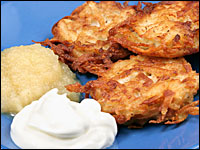
The original recipe is basically to mix it all together, and serve with browned butter on top. In our family, I often make mine more like Reiberdatschi or jewish potato latkes (like those pictured on the left), and serve with applesauce and optional sourcream. Yummy!

Bubble and Squeak
Traditionally served in England on Boxing Day (December 26th) with leftover meat.
Hint: Known to appeal to people who don't normally care for cabbage!

leftover mashed potatoes
other leftover veggies, mashed
onion, chopped
olive oil
green cabbage, thinly sliced
parsley, thyme & dill, salt

1. Heat the oil in a large skillet over medium heat. Add the onion and ½ teaspoon salt and sauté until golden, about 10 minutes. Then add garlic, and herbs and cook until softened, about 10 minutes.
2. Add the cabbage, another ½ teaspoon salt, and ½ cup water. Cover and cook slowly until the cabbage is tender, about 15 to 20 minutes, turning it occasionally. Add more liquid as necessary. When tender, uncover and raise the heat to evaporate some excess moisture, but it’s OK if it’s a little soupy.
3. Stir in the parsley and season with salt and pepper.
4. Mix the cabbage in with the mashed potatoes, and then fry in some olive oil.


Leek and Potato Soup
Leeks, washed well
spinach or other dark leafy greens (optional)
butter
potatoes
stock (chicken, beef, vegetarian) or plain water
grated cheese (Parmesan, Romano, or other)
dill
salt, pepper
cream or half-half (optional)
instant mashed potato flakes (optional)

1. Cut leeks in rings and saute in butter (I save the ends and darker ends & outer leaves for making stock -- I'll post something on making homemade stock soon!).
2. Add potatoes, remaining vegetables and stock. Cook on low until potatoes are soft. OK to let it cool at this stage. I often do this part early in the day, and finish soup later.
3. Puree in blender. Reheat.
4. Add grated parmesan cheese and spices to taste.
5. Shortly before serving, add some cream if desired (don't boil).
6. If some thickening of the soup is desired, add some instant mashed potato flakes -- it's an easy way to add substance to a soup without needing to use flour or starch.