In search of healthy and fun meals to feed my family, with an eye toward sustainable living.

Here you'll find recipes & ramblings about keeping my family fed with what's available in Alaska between local produce, a little bit of wild harvest, and the modern grocery store.
Showing posts with label holidays. Show all posts

Thursday, December 30, 2010

Colorful Holiday Menu

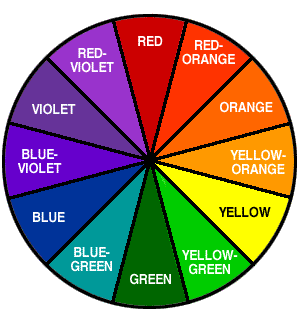
A holiday feast has to have all the major colors represented:

Brown: Smoked Turkey and it's yummy gravy
Yellow: mashed potatoes
Orange: Sweet Potato and Orange casserole
Red and Pink: cranberry sauces (3 kinds - see recipes here, incl. a Pepto-Bismol-colored dish!)
Green: Brussels Sprouts or broccoli
Blue-purple: Blaukraut (German red cabbage which turns purple)
White: King crab
Black: caviar -see below

and for New Year, it's a Southern tradition to serve Black-eyed peas for Good Luck.
I've made Hopping John before, but this year we'll need to try:

Texas Caviar (Black-eyed peas)
(Recipe by Mark Walther (a.k.a. Waldo, a real Texan!)

1 lb frozen or fresh blackeyed peas
(or if you have to 2 cans rinsed)

...1 small jar chopped Pimentos
1 11oz can White Shoepeg Corn
(Green Giant makes this, it may be a regional item, try and find if you can, otherwise "Nibblets" will probably work or if you are lucky enough to have some fresh frozen sweet corn. Shoepeg is a young, small kernel sweet corn)

Finely dice the following:
1/2 cup diced green or red bell pepper
1/2 cup diced onion
1/2 cup diced celery
1 large fresh Jalepeno pepper (seeded) or the equivalent in canned.
(it is easier to control the "heat" if you use the canned, just keep adding till it gets to where you like it)

Cook blackeyed peas according to package instructions, drain and place in a medium bowl and add the chopped ingredients, corn and pimentos.

On the stove combine the following ingredients in a pan:
1/2 cup vegetable oil
2/3 cup balsamic vinegar
3 TBS sugar
1 tsp salt
1/2 tsp pepper

Stir to dissolve sugar and bring to a boil and cool.

When cool pour over vegetables and marinate 2 to 3 hours (or overnight) in the refrigerator. Serve as a side or with Chips for an appetizer.


HAPPY NEW YEAR, Y'ALL!

Monday, October 18, 2010

Breakfast Stollen, Borealkitchen variation


Stollen is German for Christmas Bread, but in our household we eat this for breakfast any time of the year. Full of candied/dried fruit (reminiscent of English-style "Fruitcake"), stollen is typically eaten only during the winter holiday season -- but German housewives start making it in fall to let it sit and "mature". Nowadays, many will simply buy commercially-made stollen, often with marzipan filling-- yummy!

When I researched "Stollen" on Wikipedia, I found the following tidbit of history -- sure am glad we don't have to petition the pope to use butter!

The old name Striezel came from Strüzel or Stroczel, "awaken" (Old Prussian: troskeilis), which came to mean "early-baked loaf of bread". The shape of the cake was originally meant to represent the baby Jesus wrapped in swaddling clothes.The early Stollen was a different pastry, the ingredients were very different - flour, oats and water.

As a Christmas pastry, Stollen was baked for the first time at the Saxon Royal Court in 1427, and was made with flour, yeast, oil and water. The Advent season was a time of fasting, and bakers were not allowed to use butter, only oil, and the cake was tasteless and hard. In the 15th century, in medieval Saxony (a region in the eastern part of Germany, north of Bavaria and south of Brandenburg), the Prince Elector Ernst (1441 - 1486) and his brother Duke Albrecht (1443 –1500) decided to remedy this by writing to the Pope in Rome. The Saxon bakers needed to use butter, as oil in Saxony was expensive and hard to come by, and had to be made from turnips, which was unhealthy.

Pope Nicholas V (1397 – 1455), in 1450 denied the first appeal. Five popes died until finally, Pope Innocent VIII, (1432 – 1492) in 1490 sent a letter to the Prince, known as the "Butter-Letter" which granted the use of butter (without having to pay a fine) - but only for the Prince-Elector and his family and household.

Others were also permitted to use butter, but with the condition of having to pay annually 1/20th of a gold Gulden to support the building of the Freiberg Cathedral. The ban on butter was removed when Saxony became Protestant.

Over the centuries, the cake changed from being a simple, fairly tasteless "bread" to a sweeter cake with richer ingredients, such as marzipan, although the traditional Stollen is not as sweet, light and airy as the copies made around the world.


My version is much lighter and less rich than what you get during the holidays in Germany, so perhaps it is closer to the older versions? My version for everyday has almond flavoring, reminiscent of the marzipan flavor without the calories & expense! And I use the the lowest amounts of sugar and butter, so it is more bread-like than cake-like.

Borealkitchen's Breakfast Stollen

1/2 c each dried or candied fruit (I mix raisins, cranberries and apricots)
1/2 c chopped almonds
1 T yeast, dissolved in 1 c warm milk
1/2 c+ warm water, as needed
5 c+ flour
1 t salt
1/4-1/2 c sugar
1/2-1/2 c melted butter
1 egg (optional -- ok without eggs)
flavoring: 1 t Almond extract, or lemon peel, or cardamom, or cinnamon/nutmeg
Optional Glaze: powdered sugar mixed w/ water/lemon juice (I usually skip this)

I use my Kitchenaide with doughhook to mix the dough, then finish kneading on countertop.
Let rise until nearly doubled in bulk, then punch down and form 2 loaves (I use breadforms, but traditional shape is like in the picture above.
Let rise again, then bake at 375 F for approximately 1/2 hour -- test by tapping on the bottom of the loaf -if it sounds hollow, it's done!
Let cool on rack. Keeps reasonably well. We toast ours for breakfast, spread some butter, and then sprinkle w/ cinnamon sugar.

Thursday, December 31, 2009

New Year's Menu

It's New Year's Eve, and I've been cooking up a proverbial storm.
First of all there's the tradition in our family to turn the last of the Christmas turkey leftovers into a tasty batch of GUMBO, which usually is done by the dear husband -- but I made it today while he napped on the couch... Sooo, I won't be revealing any of HIS secrets of Gumbo-making, merely my own (albeit probably inferior, or at least less fiery) version.
New Years Gumbo

left-over turkey, cut into small pieces
turkey stock -lots!
oil, such as canola, sunflower, or other oil that can handle being heated
For starters, the trinity of cajun vegetables:
onions, chopped
celery, chopped
bell peppers, chopped
jalapeno peppers (or other hot peppers), chopped
optional meats: ham, sausage
garlic, crushed
pepper (both black and white, best if freshly ground)
ground cumin (a goodly amount)
cayenne pepper (to taste, or other hot pepper, ground)
ground paprika (smoked is great for flavor!)
thyme (generous amount -- this is a signature of cajun cooking!)
oregano, basil
onion powder, garlic powder
stewed tomatoes, canned ok, with liquid
bay leaf
water or stock
sweet potatoes, cubed
other veggies, such as green beans, okra, carrots, turnips...
salt, to taste
tabasco sauce
oil and flour, roughly equal amounts, for making roux
optional: seafood, such as shrimp

Note that I do not list quantities, because it's (a) a function on what you happen to have at hand right then -- in other words, clean-out-the-frig, and (b) it's a matter of taste -- give your creativity free reign: no 2 batches of gumbo should ever be the same!

I start by heating the defatted stock in my largest stockpot, adding the turkey and all other ingredients as I saute them in my biggest cast-iron frying pan: First, I sautee the onions, celery & peppers, adding the spices and cooking a bit. After they're done, dump that into stockpot, add more oil to the frying pan, and sautee the next batch: sausage, ham, etc... The sweet potatoes onward do not need to be sauteed -- they go directly into the stockpot.

While the big pot is bubbling away (on low), make the roux:
This takes some skill & confidence, but most importantly, the knowledge that it can splatter and burn you! I heat the oil in the cast-iron pan, and add flour while whisking it continuously. Heat and keep whisking until the flour turns dark, but don't burn it.
Remove from heat and spoon roux into the stockpot in small batches -- it's VERY hot and can splash when it hits the liquid -- it really helps to have a spouse or older child there who will stir the big pot after each addition of roux. Simmer the stockpot, letting flavors mingle and gumbo thicken, but keep an eye on it, stirring occasionally. If I want to add shrimp, I do it at this stage.
Note: this freezes very well -- but don't add shrimp or other seafood until thawing and re-heating.
Serve gumbo over rice.

Note on roux-making: another approach commonly seen is starting with the roux. Heat oil, add flour and whisk until dark. Then add the veggies and spices and cook, stirring. Add stock, stirring... Note that this approach requires all your ingredients to be ready to go, and you do a lot of continuous stirring, and my wrist/arms need breaks -- so I do like to do this in batches.

For a recipe (with actual quantities), go here for a Paul Prudhomme gumbo.

Next, I cooked Hoppin' John, which is a Southern tradition, made from Black-eyed peas (a.k.a. cowpeas), and I made both a vegetarian and traditional version.

Hopping John
tradional version: cook cowpeas with ham, hamhock or bacon
my own vegetarian creole version:
black-eyed peas, soaked in warm water for a few hours or overnight, drained
oil
onions, chopped
celery, chopped
bell peppers, chopped
garlic, crushed
pepper (both black and white, best if freshly ground)
cayenne pepper (to taste, or other hot pepper, ground)
ground paprika (smoked is great for flavor!)
thyme (generous amount -- this is a cajun staple)
optional: onion powder, garlic powder, mustard powder
bay leaf
water or stock
salt, to taste
greens, such as kale or collard greens.

Heat oil and saute the veggies. Add garlic and all spices, cooking for a little while, then add the drained black-eyed peas, bay leaf and enough water/stock to cover. Cook until peas are soft. Add salt.
While legumes are cooking, prepare the greens: wash, remove tough stems, and cut. Add into peas when they are nearly all the way cooked. Serve with cornbread.

Lastly, as I type on my new laptop (in the kitchen, isn't that nifty!!!), I've got 2 different versions of poached pears simmering on the stove. I posted the recipe yesterday, but here's what I've learned today when I found this treatise on How to make poached pears (go there if you want actual measurements!):
  • This works with Asian pears too!
  • Keep those pears covered with some parchment paper
  • there are lots of flavors you can add: vanilla, cloves, allspice, etc
  • try replacing some of the water with wine
  • add some dried fruit to the poaching liquid at the end
  • serve hot or cold, by itself or with a sauce
  • it's a great way to preserve fruit you can't eat fast enough...
Saturday, December 26, 2009

Menu for last week of December

It's that wonderful week after Christmas, when the frig is full, but the calendar is not!

We're about cookied-out, and I find myself craving mostly fruits and vegetables. Perfect for all that wonderful produce from the CSA box: carrots, taters, celery root, cabbage, pears, apples, oranges, greens, etc.
At Costco I bought 2 special treats: King Crab, and Leg of lamb, imported from Australia.
The lamb will last me a few month: I cut it up into chunks and freeze it in 1-pound portions, plus I make stock from the scraps...) I love making an indian feast with lots of vegetarian dishes plus lamb korma or lamb stew!

An old Southern tradition is to eat black-eyed peas and greens on New Year's Day -- so we're adding this to our family tradition. My Swedish-American husband is the force behind our family's predeliction for CAJUN food -- every year for the last 17 we turn the turkey left-over into a great big batch of GUMBO. It freezes very well!

SAT "Boxing Day": leftover turkey, mashed pototoes, etc.
SUN: Polenta w/ red sauce, super-garlicky garlic bread, big green salad
MON: Cajun Flanks & greens, over rice, oven-roasted celery root
TUE: Bubble & Squeek (potatoes and cabbage)
WED: Cardamon Lamb Curry (recipe from Dingo Dave Downunder), other veggies & rice
THUR: Gumbo and King Crab (more here)
FRI: Cajun black-eyed peas, mess of greens, cornbread
SAT: Corned beef, potatoes & cabbage

Recipe for Hot-buttered rum MIX


For the holidays this year, we made, and consumed, large quantities of this:

Hot-buttered Rum Mix
1 stick butter (1/2 cup)
2 c brown sugar
1 t cinnamon
1/2 t nutmeg
1/4 t cloves
1/4 t cardamon (optional) a favorite spice in our household

Mix it all together & store in jars.
No need for refrigeration.

To use, put 1-2 teaspoons in a mug, add hot water and rum to taste.
Can also be used to flavor hot cocoa, coffee or tea.

BUTTER BEER (Hogwarts-style)
Hot version: Add mix to hot water, and optional, stir in vanilla icecream, too.
Cold version (rootbeer-float style): Add mix to cream soda, stir, then add icecream.

Tuesday, December 22, 2009

Baking European Christmas cookies

I did a bit of baking today, trying to catch up -- cookie tins are once again empty on account of maraundering teenagers...

I challenged myself to bake (which I love) a variety of cookies (a must at Christmas-time) without a whole lot of dish-washing (which I don't care for)... it's all in the name of efficiency, don't you know!

So, without washing any mixing bowls, spatulas, etc until the end of the exercise, here's what I figure can be made one after the other without looking at the sink until the very end:

Zimtsterne (Cinnamon stars, German)
Spritz (cookie press cookies, int'l) or Scottish shortbread cookies
Spekulatius (very thin spice cookies, German/Danish)
Rokkekager (literally translates to "Rock cookies", Scandinavian)

ZIMTSTERNE (Cinnamon stars) -this is completely wheat/gluten-free
3 egg whites
1/2 # granulated sugar
3 t cinnamon
2 c grated almonds (save approx 1/4 c for dusting pastry board) -- I grind my own, blanching them first
1/2 t almond extract

Beat eggwhites and as they start foaming, slowly add sugar. Set aside some of this for topping.
Transfer to another bowl where you carefully mix in the remaining ingredients. Keep adding nutflour until dough holds together enough to be rolled out on dusted pastry board. Cut star shapes, brush w/beaten eggwhites, and bake on greased cookie sheet at 300F for approx 30 min, until golden brown and slightly chewy.
PS: mine never turn out looking as nice as this picture I found on google...

SPRITZ (Cookie press)
there's lots of recipes. Basically calls for butter, sugar and flour, plus egg yolks, which is why I make them after Zimtsterne, where I have leftover egg yolks! Just use same mixing bowl that the eggwhites were beaten it -- (in case of nut allergies, be sure not to use any tools that touched nuts)...
Typically this dough needs to chill, so move on to the next recipe, without washing that bowl!

Here's my version (based on Joy of Cooking -adjusted to use up the 3 egg yolks)
1.5 c butter, softened
1 c sugar
3 egg yolks
1.5 t vanilla or almond extract
3 c to 3.5c flour
3/4 t salt
optional: add ground almonds as well -- adjust flour as needed

SPEKULATIUS
again, butter, sugar, flour, plus spices. Keep on using the same bowls to soften the butter, mix the dough, etc...

1/2 # butter, softened at room temp
1 # sugar
2 eggs
grated rind of 1 lemon
4.5 c flour
2 t cinnamon
1/2 t ground gloves
1/4 t ground cardamom
optional: slivered almonds
(some recipes call for ground almonds as well)

Cream butter and sugar, then add eggs, one at a time. Fold in all dry ingredients. Chill dough (instructions are for overnight), but my Alaskan trick is to stick them outside, already spread 1/8th inch thick on the greased cookie sheet (I cover w/ plastic wrap first).
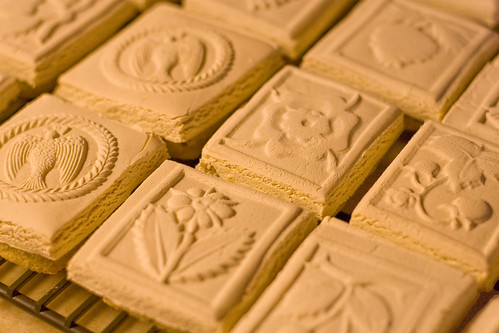
Traditionally, Spekulatius are "relief-printed" cookies (often w/ windmills or other designs), but sure could bake them plain.
Sometimes they have a thin glaze of eggwhite wash, and perhaps sprinkled w/ a bit of sugar.
Bake at 350F (I've even seen lower temps, like 300) until lightly golden.
As soon as you remove them from oven, cut them apart into squares.

From Germanfood.about.com: The history of Springerle is quite interesting. It is said that a effigy of an animal was used in place of an actual animal sacrifice for those who could not afford the real thing. These imprints were used during pagan midwinter festivals at which people prayed for an early spring. They were commonly exchanged instead of Christmas cards and Biblical scenes on the cookies served to educate the illiterate in the middle ages. For more on the history, check out godecookery.com.


ROKKEKAGER (Rock cookies)
1 c butter
1.5 c brown sugar
3 eggs
2.5-3 c flour
1/2 t salt
1 t baking soda
1 t cinnamon
1/2 t nutmeg
1/4 t cloves
1 t vanilla
3 c mixed candied fruit and/or raisins
1 c each hazelnuts and pecans/walnuts

cream butter and sugar, add eggs. Add dry ingredients & fruit & nuts.
Drop by the spoonful onto baking sheets. Bake 8-10 min at 375F. These store well (but beware if you find them at Easter -- then they may resemble Hagrid's rock cakes!)

Phew, now better get to some dishes...

Wednesday, November 25, 2009

Cranberries at Thanksgiving

We like our cranberries here in the North, and this year there will be not just one, but 3 sauces at our Thanksgiving table.
First, the traditional, standard
Cooked Cranberry Sauce
2 c whole cranberries
1 c sugar
1 c water

Combine in sauce pan and bring to boil. Reduce heat, stirring occasionally, and cook for 10 minutes. Keeps well.

Next, NPR's Susan Stamberg shares this recipe every year at Thanksgiving, and I've always wanted to try this unusual Pepto-Bismal pink relish!
Mama Stamberg's Cranberry Relish

2 c whole raw cranberries, washed
1 small onion
3/4 cup sour cream
1/2 cup sugar
2 tablespoons horseradish from a jar ("red is a bit milder than white")

Grind the raw berries and onion together. ("I use an old-fashioned meat grinder," Stamberg says. "I'm sure there's a setting on the food processor that will give you a chunky grind, not a puree.") Add everything else and mix. Put in a plastic container and freeze.

Early Thanksgiving morning, move it from freezer to refrigerator compartment to thaw. ("It should still have some little icy slivers left.") The relish will be thick, creamy and shocking pink. ("OK, Pepto Bismol pink.") Makes 1 1/2 pints.

Last, if not least,
Cranberry Orange Relish
1 medium orange, washed, preferrably organic
2 c cranberries
1 c sugar
cinnamon, optional

Cut oranges, skin and all, into sections, and remove seeds.
Chop all ingredients in food processor. Serve raw, or you can cook this too.

Friday, October 30, 2009

Halloween foods

Halloween is a good excuse to come up with some fun foods. As I'm planning for the Nature Center's Halloween party, I've been searching the web and came across some great recipes.

Gotta love these fingers -- this came from cookwithme.com, where you also can see hot-dog-mummies, graveyards cakes and deviled-egg-eyeballs...

Since I'm looking for healthy, I love these apple-bites dentures where the teeth are almonds. I found them on biccin.com.


These cute eyes looking out of their mummy wrap are probably just oreos & icing -- I found these and much more on a site called recipecommander.

That reminds me, I should see if I have any jello around -- I'll make a batch and mix those with gummi worms - yummers!


Perhaps not specifically Halloweenish, but cute as can be are edible Penguins made from hard-boiled eggs, olives and carrots on Mountainpulse. Check them out -- they are sooo cute!